
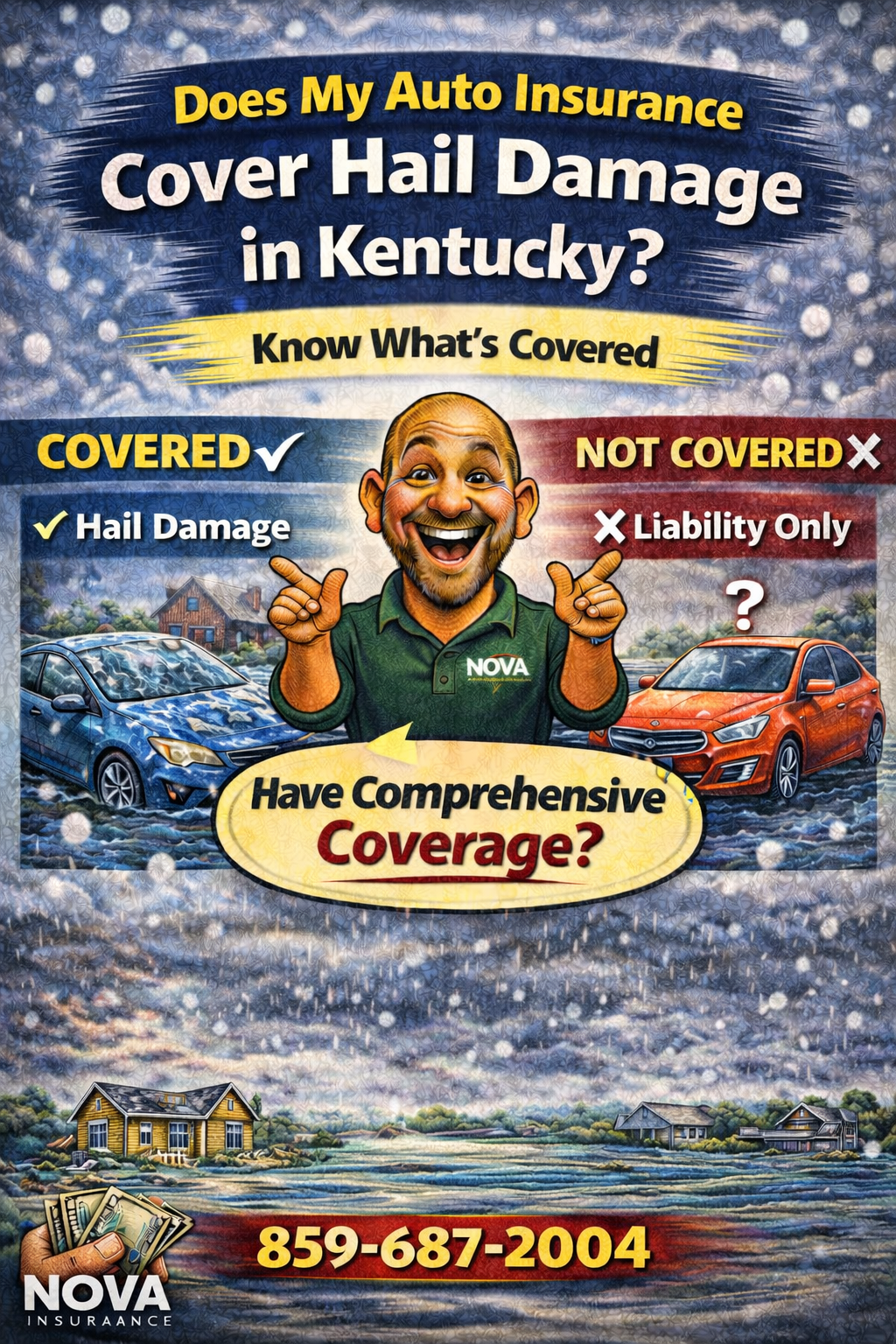
Does My Auto Insurance Cover Hail Damage in Kentucky?
TLDR: Auto insurance only covers hail damage if you have comprehensive coverage, the optional portion of your policy that covers non-collision events like hail, theft, and weather damage. If you carry only liability coverage (or liability plus collision), hail damage to your vehicle is not covered. Kentucky’s hail season runs March through September, with some of the most damaging storms occurring in spring.
We’ve spent this week closing gaps in homeowners coverage. But your home isn’t the only thing sitting in a Kentucky hailstorm, so is your car.
The question of whether auto insurance covers hail damage is one of the most common we field every spring when storm systems start rolling through Central Kentucky. The answer isn’t complicated, but the confusion comes from how auto insurance is structured, specifically, the difference between what’s required and what actually protects your vehicle.
Let’s sort it out.
Why Hail Damage Coverage Isn’t Automatic on Auto Insurance
Kentucky law requires drivers to carry liability insurance, coverage that pays for damage you cause to other people and their property. Liability doesn’t cover damage to your own vehicle. That’s a critical distinction.
Damage to your own vehicle comes from two sources:
Collision coverage: Covers damage to your vehicle from hitting another car or object.
Comprehensive coverage: Covers damage to your vehicle from events other than collisions, including hail, wind, falling objects, fire, theft, vandalism, flooding, and hitting an animal.
Hail damage falls under comprehensive. If you don’t have comprehensive, you have no coverage for hail. Period.
Here’s the problem: many Kentucky drivers, especially those with older vehicles they own outright, drop comprehensive to save money on their premium. When the hailstorm hits, they discover what they gave up.
How Comprehensive Coverage Works for Hail in Kentucky
If you have comprehensive coverage and a hail event damages your vehicle, here’s how the claim works:
Step 1: You file a comprehensive claim with your auto carrier. Hail is a covered peril, no fault question, no other driver involved.
Step 2: An adjuster assesses the damage. For significant hail events in Kentucky (where dozens or hundreds of vehicles may be affected simultaneously), your carrier may use mobile claims units or photo/video documentation.
Step 3: Your carrier issues payment for the repair minus your comprehensive deductible. Common comprehensive deductibles in Kentucky: $500, $1,000, or $1,500.
Step 4: You take your vehicle to an approved shop (or a shop of your choice in most cases). Paintless dent repair (PDR) is the standard method for most hail damage, it’s less expensive than traditional bodywork and preserves the original paint.
One important nuance: if your vehicle sustains hail damage that exceeds its actual cash value (ACV), the carrier may total it rather than repair it. This is more common with older vehicles. Your payout is the ACV, not necessarily what you paid or what you owe on the vehicle.
The Kentucky Hail Reality
Kentucky is not a state where hail is a rare event. Central Kentucky sits in a region that sees significant severe weather activity from late winter through summer:
-
Hail season: March through September, with peak activity in April, June
-
Hail size ranges: Kentucky regularly sees golf-ball-sized hail (1.75″) capable of causing significant dents and glass damage
-
Simultaneous exposure: Kentucky hailstorms often affect hundreds or thousands of vehicles in a single event, parking lots, neighborhoods, and rooftops all at once
-
Storm tracks: Severe storm systems often move northeast through the Lexington and Nicholasville corridor from south and southwest, the same path that produces significant wind and hail activity
In a significant hail event, repair shops fill up fast. If you have comprehensive coverage, getting your vehicle into a reputable shop quickly becomes a priority, wait times after a major hail event can stretch to four to six weeks.
Real Scenario: Marcus’s Truck in Nicholasville
Marcus owned a 2019 pickup he’d bought outright the year before. When he paid it off and removed the lender’s required coverage, he dropped comprehensive to save $18/month, about $216/year.
In May, a severe thunderstorm dropped golf-ball-sized hail across Jessamine County. The hood of his truck took the worst of it, 60+ dents, damaged roof rails, cracked windshield. The repair estimate: $5,800.
His auto policy: liability and collision only. No comprehensive. His payout: $0.
The PDR shop quoted the repair at $4,100 with an aftermarket windshield; original equipment brought it to $5,800. Marcus paid out of pocket.
Comprehensive coverage for his truck: $280/year. His savings from dropping it: $216/year. His net loss for that decision: $5,584.
Hail Damage and Your Comprehensive Deductible
Your comprehensive deductible is the amount you pay before coverage kicks in. This matters more than most drivers realize when it comes to hail.
Hail Damage Amount$500 Deductible$1,000 Deductible$1,500 DeductibleMinor (10 to 20 small dents)$1,200 repair → you pay $500$1,200 repair → you pay $1,000$1,200 repair → you pay $1,200Moderate (30 to 50 dents, cracked glass)$3,500 repair → you pay $500$3,500 repair → you pay $1,000$3,500 repair → you pay $1,500Severe (roof, hood, all glass)$7,000+ repair → you pay $500$7,000+ repair → you pay $1,000$7,000+ repair → you pay $1,500
For drivers with moderate to significant hail risk (i.e., most of Central Kentucky), a $500 comprehensive deductible provides far better protection than a $1,500 deductible, and the annual premium difference between those deductible levels is often only $30 to $60/year.
Will Filing a Hail Claim Raise My Auto Insurance Rates?
This is the question everyone asks. The answer in Kentucky: it depends on your carrier, but comprehensive claims, particularly weather-related claims, are generally treated differently than collision claims.
Hail is a weather event, not a “fault” event. Most standard auto carriers in Kentucky do not surcharge your premium for a single comprehensive claim, particularly one caused by a named weather event. Your claims history is a factor, but one comprehensive weather claim typically does not trigger a rate increase with most carriers.
However: some carriers do surcharge after multiple comprehensive claims or use a broader “claims history” factor. Ask your agent to confirm your carrier’s specific policy before making a claim decision.
The general rule: if the damage exceeds your deductible by a meaningful amount, file the claim. If the damage is within a few hundred dollars of your deductible, paying out of pocket may be worth considering to preserve your claims history.
5 Things to Do After a Hail Event in Kentucky
-
Document the damage before moving your vehicle: photograph every panel, the roof, glass, and any interior damage from moisture if glass was broken. Video works well for showing the scope of damage.
-
Call your agent, not the general claims line first: your local agent can set expectations on deductibles, shop options, and timeline before you file.
-
Choose your repair shop carefully: Kentucky law gives you the right to choose your own shop. Look for shops with specific experience in paintless dent repair (PDR) and hail work. Post-storm, many out-of-state “storm chasers” set up temporary shops, use local, established shops with verifiable warranties.
-
Get your car assessed even if damage looks minor: minor surface dents can hide structural damage, bent trim, or glass microcracking. An assessor who specializes in hail can find things you’d miss.
-
Don’t wait if you have comprehensive: after a major hail event, shops fill up immediately. Getting on a waiting list within 24 to 48 hours of the storm is often necessary to secure a reasonable repair timeline.
👉 Not sure if your auto policy includes comprehensive coverage, or whether your deductible is set right for Kentucky’s hail season? A coverage review takes about 20 minutes and might save you thousands. Call us at 📞 859-687-2004: or start your review here.
Nova Insurance Group, 99 Wind Haven Dr., Suite 1, Nicholasville, KY 40356
Final Takeaways
✅ Auto insurance only covers hail damage if you have comprehensive coverage, liability-only or liability-plus-collision policies do not cover hail. ✅ Comprehensive coverage is the “everything except collision” portion of your auto policy, it covers hail, theft, flooding, fire, and hitting an animal. ✅ Kentucky’s hail season runs March through September, dropping comprehensive to save money is a high-risk decision in this region. ✅ Most Kentucky carriers do not surcharge for a single weather-related comprehensive claim, hail is a covered event, not a fault event. ✅ After a hail event, choose an established local shop with PDR experience, out-of-state storm chasers are common and often problematic. ✅ A $500 comprehensive deductible typically costs only $30 to $60 more per year than a $1,500 deductible, worth it in Kentucky’s hail environment.
Frequently Asked Questions
Does auto insurance cover hail damage in Kentucky?
Yes, if you have comprehensive coverage. Comprehensive covers hail damage, along with other non-collision events like theft, flooding, fire, and animal strikes. Liability-only or liability-plus-collision policies do not cover hail. Check your auto policy declarations page for a “comprehensive” line item, if it’s not there, you don’t have hail coverage.
What type of car insurance covers hail in Kentucky?
Comprehensive coverage is the policy component that covers hail damage. It’s optional in Kentucky (only liability is required by law), but almost always worth carrying on vehicles with significant value. If your car is financed or leased, your lender likely requires comprehensive as a loan condition.
Will filing a hail damage claim raise my insurance rates in Kentucky?
Typically no, most carriers treat weather-related comprehensive claims differently from collision or at-fault claims. Hail is a non-fault event. A single comprehensive weather claim generally does not trigger a rate surcharge with most standard carriers. However, policies vary, so ask your agent to confirm how your specific carrier treats comprehensive claims before filing.
How does the hail damage claim process work in Kentucky?
File a comprehensive claim with your carrier, document all damage with photos and video, get an adjuster assessment, then take your vehicle to a qualified repair shop for paintless dent repair (PDR) or traditional bodywork as appropriate. You pay your comprehensive deductible; your carrier covers the rest up to the vehicle’s actual cash value.
What is paintless dent repair (PDR) and is it covered by insurance?
PDR is a technique that removes hail dents by massaging the metal from behind the panel, preserving the original paint and finish. It’s typically less expensive than traditional bodywork and is the standard repair method for most hail damage. Most auto insurers accept PDR as the standard of repair for hail damage and it is covered under comprehensive claims.
Should I drop comprehensive coverage on my older car in Kentucky?
This is a judgment call based on your vehicle’s value versus the cost of coverage. A useful rule of thumb: if your vehicle’s actual cash value is less than 10 times your annual comprehensive premium, dropping comprehensive may make financial sense. But in Kentucky’s hail environment, be aware that a single moderate storm can total a $6,000 to $8,000 vehicle, and without comprehensive, that loss is entirely yours.
📞 859-687-2004. Prepared. Not panicked.
Video Transcript: Hail Damage to Auto
A hailstorm rolled through Lexington last June.
The Dixons’ Suburban looked like a golf ball range.
Repair bill? Nine thousand dollars.
Insurance covered all but their five-hundred deductible.
Here’s how hail coverage works.
Comprehensive coverage, “comp”, covers damage that isn’t a crash.
And yes, that includes hail.
No comp on your auto policy? No hail coverage.
The Dixons had comp. Five hundred deductible.
Carrier paid the rest. Eighty-five hundred.
Three things people don’t know about hail claims.
The insurance industry would prefer it stay that way.
One, file fast.
Most policies want notice within thirty days.
Wait too long, claim denied.
Two, get multiple estimates.
First body shop quote is almost never the real number.
Paint matching, sensor work, hood replacement, adds up.
Three, ask about diminished value.
Even after a perfect repair, your car sells for less.
Some carriers pay you for that. Most won’t volunteer it.
The Dixons’ neighbor had no comp.
Same storm. Same kind of dents.
Nine grand. Out of pocket.
By the way, this is part of why your KY auto rate keeps climbing.
We’re in “hail alley.” Storms hit harder, more often.
If you don’t have comp on your auto policy, call Nova right now.
859-687-2004.
We’ll add it. Or shop you to a carrier where it’s bundled in.
About a hundred bucks a year for most cars.
That’s what an agent who works for YOU does.
Written by Steve Straub, COO of Nova Insurance Group and a licensed Kentucky insurance agent (NPN 19734248). This article is general information current as of March 2026. Your coverage depends on your policy and insurance company. Questions? Call 859-687-2004 or email team@novainsurancegroup.com.
